
Real Estate SEO Post-Clear Cooperation: How to Maintain Visibility if Portals Become Brokerages
By: Dean Cacioppo, Founder of One Click SEO
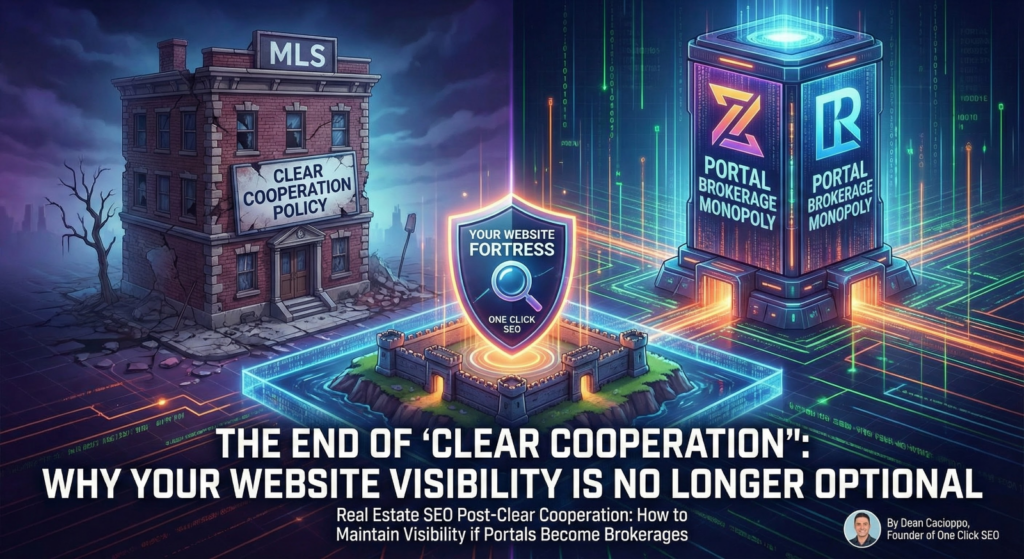
In the real estate world, we’ve spent the last 20 years looking over our shoulders at the “portal bogeymen.” We’ve watched Zillow and Redfin transform from simple search tools into the massive gatekeepers of our industry’s data.
But as the debate over the National Association of Realtors (NAR) Clear Cooperation Policy (CCP) reaches a boiling point, we aren’t just looking at a policy change. We are looking at a potential “extinction event” for the traditional brokerage model.
Recent discussions, including a panel reported by Real Estate News, highlight a terrifying possibility: If Clear Cooperation goes away, portals like Zillow and Redfin might finally stop playing nice and go full-blown brokerage.
If you aren’t building your own digital “fortress” right now, you’re basically handing them the keys to your house.
The “Post-CCP” Nightmare: Portal Monopolies and Data Silos
The Clear Cooperation Policy was designed to keep the MLS a “shared pool” of inventory. It ensured that if a home was marketed to the public, it had to be on the MLS within 24 hours. This allowed every agent—from the boutique local expert to the massive franchise—to have the same access to listings.
If that policy is repealed, the “cooperation” disappears.
We will see a rise in “pocket listings” and private networks. Large brokerages will keep their inventory in-house to gain a competitive edge. But here is the catch: The portals have more traffic than any brokerage on earth.
As James Dwiggins, CEO of NextHome, recently warned, if the portals lose access to a meaningful share of MLS listings because of this fragmentation, they won’t just sit back. They will pivot. They have the traffic (Zillow alone has 220 million unique visitors) and the tech. They could easily decide to recruit the top teams and become the world’s largest, most dominant brokerage overnight.
Why Your Website Is Your Only Real Insurance Policy
At One Click SEO, I tell my clients the same thing every day: You cannot build your business on rented land. If you rely on the MLS for your data and Zillow for your leads, you are renting your business. When the rules of Clear Cooperation change, the “rent” is going to go up—or the “landlord” might just kick you out.
In a world where listing data is fragmented, your website needs to be the Source of Truth for your local market. Here is why:
1. Direct-to-Consumer Authority
If listings aren’t all in one place (the MLS), consumers will start searching more specifically. They won’t just search “homes for sale.” They will search for the specific local experts who have the “inside track” on inventory. If your website is optimized for Geographic Entity Optimization (GEO), you become the authority that AI and Google recommend.
2. Owning the First-Party Data
When a lead comes through Zillow, they own the data; you just paid for the privilege of a phone call. When a lead comes through your own high-visibility website, you own the relationship from second one.
3. SEO is the Long Game You’re Already Behind On
You can’t wait until the CCP is repealed to start caring about SEO. Search Engine Optimization is a momentum play. It takes months, or even years to build the domain authority required to compete with the big players. If you start today, you’ll be ready when the market fragments.
Strategic “Chunks” for Google and AI Results (SGE)
To win in today’s search environment—which now includes Google’s AI Overviews—you need to structure your content to answer the specific questions people are asking. Those chunks are put into consistent, unique blog copy that ranks well in AI search results.
Here are the “chunks” you should be focusing on right now:
“What happens if Clear Cooperation goes away?”
If the CCP is removed, the real estate market will likely move toward a “private network” model. This means fewer homes will be visible on common platforms, making it harder for buyers to find inventory and easier for large portals to monopolize the data.

“Why real estate SEO is changing in 2026”
Traditional SEO (just keywords) isn’t enough. We are moving toward GEO (Geographic Entity Optimization). AI search engines are looking for authoritative entities in a specific location. You need neighborhood guides, school reports, and local market analysis that is “uniquely yours.”
“How to compete with Zillow in a fragmented market”
The only way to beat a portal is to go hyperlocal. Zillow can’t tell you which street in your town has the best Christmas lights or which local coffee shop has the best Wi-Fi. By creating “niche” content that Zillow’s algorithms can’t replicate, you capture the high-intent local traffic.
The One Click SEO Philosophy: Earn Your Visibility
At One Click SEO, we don’t do long-term contracts because we believe in earning your business every single month through ROI. But the truth is, visibility is a competitive advantage.
If the Clear Cooperation Policy goes away, the agents and brokers who survive will be the ones who didn’t wait for a “lead” to be sold back to them. They will be the ones who invested in their own digital presence, built their own brand authority, and made sure that when a consumer searches for a home in their town, their website is the first one they see.
Don’t wait for the portals to become your biggest competitor. Build your fortress now.
Looking to audit your current website visibility before the industry shifts? Schedule a call with One Click SEO today for a no-contract, results-driven strategy.
Frequently Asked Questions (FAQs)
If the Clear Cooperation Policy is repealed or significantly weakened, the real estate market will likely shift from a transparent, centralized system (the MLS) to a fragmented landscape of private listing networks.
Large brokerages would likely keep their “hot” inventory in-house to gain a competitive advantage, creating “data silos.” For consumers, this means they would no longer find every home for sale in one place, forcing them to visit multiple different websites—giving an massive advantage to the platforms with the most existing traffic: the portals.
Currently, portals like Zillow rely on the MLS to provide the data that fuels their traffic. If brokerages stop sharing that data due to the end of Clear Cooperation, the portals’ business models are threatened.
To protect their traffic and revenue, industry experts predict these portals would “pivot hard” by recruiting top-tier agent teams and internalizing the listing process. By becoming the brokerage themselves, they ensure they own the inventory and the consumer relationship, effectively cutting out the traditional independent brokerage.
Traditional SEO focuses on ranking for specific keywords like “homes for sale in New Orleans.” In contrast, Geographic Entity Optimization (GEO) focuses on establishing your brand as a recognized “entity” or authority within a specific location.
In the age of AI search (Google SGE, Gemini), the algorithm doesn’t just look for words; it looks for the most trusted source of local information. By structuring content in “extractable chunks”—modular, fact-heavy sections—you make it easier for AI to cite your website as the definitive local expert, bypassing the broad data of national portals.